SAP C-THR81-2505 Exam Questions 2026 - Instant Access, just revised
Wiki Article
P.S. Free & New C-THR81-2505 dumps are available on Google Drive shared by Free4Dump: https://drive.google.com/open?id=1_ftdm78scvhkxbfY4mTZ2fKjkgeoSYZa
Our company is professional brand established for compiling C-THR81-2505 exam materials for candidates, and we aim to help you to pass the examination as well as getting the related certification in a more efficient and easier way. Owing to the superior quality and reasonable price of our C-THR81-2505 Exam Materials, our company has become a top-notch one in the international market. So you can totally depend on our C-THR81-2505 exam torrents when you are preparing for the exam. If you want to be the next beneficiary, just hurry up to purchase.
SAP C-THR81-2505 Exam Syllabus Topics:
| Topic | Details |
|---|---|
| Topic 1 |
|
| Topic 2 |
|
| Topic 3 |
|
| Topic 4 |
|
>> Reliable C-THR81-2505 Test Practice <<
Valid C-THR81-2505 Test Pattern | C-THR81-2505 Latest Exam Duration
For candidates who prefer a more flexible and convenient option, SAP provides the C-THR81-2505 PDF file, which can be easily printed and studied at any time. The PDF file contains the latest real SAP Certified Associate - SAP SuccessFactors Employee Central Core (C-THR81-2505) questions, and C-THR81-2505 ensures that the file is regularly updated to keep up with any changes in the exam's content.
SAP Certified Associate - SAP SuccessFactors Employee Central Core Sample Questions (Q50-Q55):
NEW QUESTION # 50
This is a global customer and HR admins will be assigned based on legal entity. The HR admins should be getting approval workflows from their target population.
How can you define this in one workflow?
- A. Create a dynamic role using the Legal Entity filter and assign the Resolver type as dynamic group
- B. Create a dynamic role for each legal entity and assign the Resolver as the head of the legal entity.
- C. Create dynamic groups per each legal entity and add the necessary approver steps.
- D. Create permission groups for each legal entity and assign them to the HR admin role.
Answer: A
Explanation:
For a global customer where HR admins are assigned based on legal entities and need to receive approval workflows for their target population, you can configure the workflow as follows:
* Create a Dynamic Role using the Legal Entity filter.
* Assign the Resolver Type as a Dynamic Group to ensure the workflow automatically routes to the correct HR admin based on the legal entity.This configuration avoids creating multiple static workflows and simplifies management by dynamically resolving approvers based on the legal entity.
Scenario 2: Approvals for Self-Service
NEW QUESTION # 51
In a generic object with a picklist field, what must be entered in the Valid Values Source?
- A. Picklist Value External Code
- B. Legacy Picklist ID
- C. Picklist Value ID
- D. Picklist Code
Answer: D
Explanation:
When configuring a picklist field in a generic object within SAP SuccessFactors Employee Central, the Valid Values Source must be set to the Picklist Code. This configuration links the field to the appropriate set of predefined values, ensuring data consistency and integrity.
Options A, C, and D are not applicable in this context:
A . Picklist Value ID
This refers to individual entries within a picklist and is not used to define the source of valid values for a field.
C . Legacy Picklist ID
Legacy Picklist IDs pertain to older configurations and are not relevant for defining valid value sources in the current framework.
D . Picklist Value External Code
This represents specific external codes for picklist entries and is not used to set the valid values source for a field.
NEW QUESTION # 52
What is generic object foTranslation used for in SAP SuccessFactors Employee Central?
- A. To translate any generic object field labels in the instance
- B. To translate XML and MDF FO field labels
- C. To translate MDF FO field labels
- D. To translate XML FO field labels
Answer: C
NEW QUESTION # 53
Based on the screenshot below, can you identify any errors on the definition of the business rule to Default Position Attributes? Note: There are 2 correct answers to this question.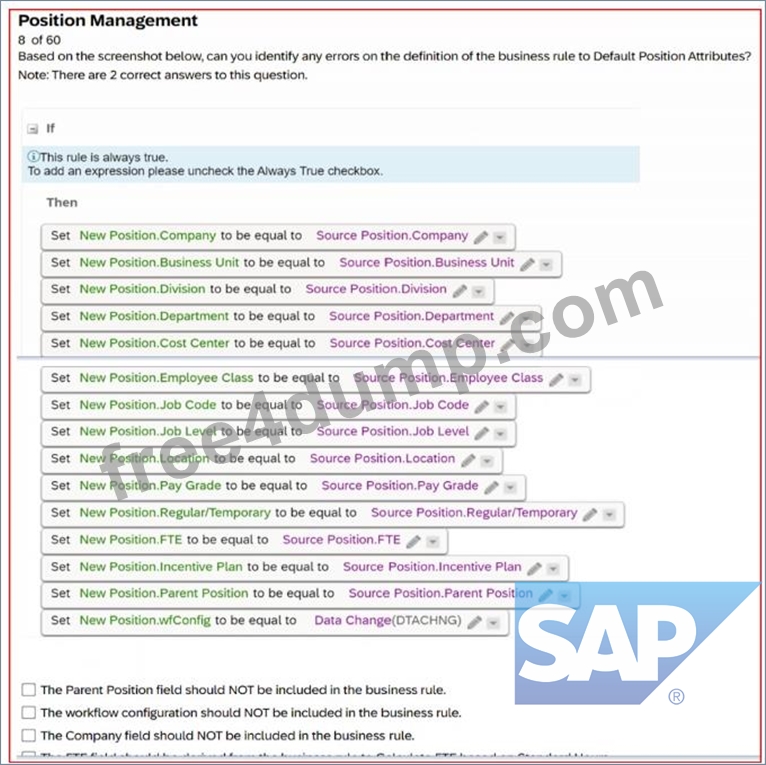
- A. The Company field should NOT be included in the business rule.
- B. The Parent Position field should NOT be included in the business rule.
- C. The FTE field should be derived from the business rule to Calculate FTE based on Standard Hours.
- D. The workflow configuration should NOT be included in the business rule.
Answer: B,C
Explanation:
C . The Parent Position field should NOT be included in the business rule:
The Parent Position field is typically derived automatically based on position hierarchy and does not require explicit inclusion in a business rule for defaulting position attributes.
D . The FTE field should be derived from the business rule to Calculate FTE based on Standard Hours:
The FTE (Full-Time Equivalent) value should be calculated using a dedicated rule that accounts for standard hours, rather than being directly included in a defaulting rule.
Including these fields inappropriately can lead to data inconsistencies or rule execution issues.
NEW QUESTION # 54
In which business rule scenario do you use model base objects? Note: There are 2 correct answers to this question.
- A. Trigger Rules to Display Internal Job History
- B. Trigger Rules for Hire/Rehire
- C. Trigger Workflows
- D. Save Changes to Foundation Objects
Answer: B,C
Explanation:
In SAP SuccessFactors Employee Central, model base objects are utilized in business rules for scenarios such as:
A . Trigger Workflows
Model base objects can be used to define conditions that initiate workflows, automating processes based on specific data changes or events.
C . Trigger Rules for Hire/Rehire
During the hire or rehire process, model base objects help in setting default values, validating data, and enforcing business logic to ensure compliance with organizational policies.
Options B and D are not typically associated with model base objects in business rules:
B . Trigger Rules to Display Internal Job History
Displaying internal job history is generally managed through reporting and does not involve model base objects in business rules.
D . Save Changes to Foundation Objects
While foundation objects are essential for organizational data, saving changes to them does not typically require the use of model base objects in business rules.
NEW QUESTION # 55
......
What is more difficult is not only passing the SAP C-THR81-2505 Certification Exam, but the acute anxiety and the excessive burden also make the candidate nervous to qualify for the SAP Certified Associate - SAP SuccessFactors Employee Central Core certification. If you are going through the same tough challenge, do not worry because SAP is here to assist you.
Valid C-THR81-2505 Test Pattern: https://www.free4dump.com/C-THR81-2505-copyright-torrent.html
- In-depth of Questions SAP Reliable C-THR81-2505 Test Practice ➰ Easily obtain ⇛ C-THR81-2505 ⇚ for free download through ( www.examcollectionpass.com ) ????Valid C-THR81-2505 Exam Dumps
- Top Reliable C-THR81-2505 Test Practice Free PDF | Efficient Valid C-THR81-2505 Test Pattern: SAP Certified Associate - SAP SuccessFactors Employee Central Core ???? Open ▛ www.pdfvce.com ▟ enter 【 C-THR81-2505 】 and obtain a free download ⏬C-THR81-2505 Valid Dumps Questions
- Quiz 2026 SAP C-THR81-2505: Newest Reliable SAP Certified Associate - SAP SuccessFactors Employee Central Core Test Practice ⛹ Search for ➥ C-THR81-2505 ???? and download exam materials for free through ▷ www.troytecdumps.com ◁ ????C-THR81-2505 Latest Exam Pass4sure
- Buy Pdfvce SAP C-THR81-2505 Exam Dumps Today and Get Free Updates for 1 year ???? ➥ www.pdfvce.com ???? is best website to obtain [ C-THR81-2505 ] for free download ????Reliable C-THR81-2505 copyright Files
- Reliable C-THR81-2505 copyright Files ???? C-THR81-2505 Practice Questions ???? Valid C-THR81-2505 Exam Pdf ???? Open “ www.troytecdumps.com ” and search for ➡ C-THR81-2505 ️⬅️ to download exam materials for free ????Pass4sure C-THR81-2505 Exam Prep
- Pass Guaranteed Quiz Latest SAP - Reliable C-THR81-2505 Test Practice ???? Search for 「 C-THR81-2505 」 on [ www.pdfvce.com ] immediately to obtain a free download ????C-THR81-2505 Valid Dumps Questions
- Successfully Get the Quality SAP C-THR81-2505 Exam Questions ???? Search for ✔ C-THR81-2505 ️✔️ and download exam materials for free through ☀ www.pass4test.com ️☀️ ????Reliable C-THR81-2505 Exam Cost
- Valid C-THR81-2505 Exam Dumps ???? C-THR81-2505 Test Registration ???? C-THR81-2505 Real Question ???? ⇛ www.pdfvce.com ⇚ is best website to obtain ▶ C-THR81-2505 ◀ for free download ????Valid C-THR81-2505 Exam Dumps
- C-THR81-2505 Study Materials Review ???? Valid C-THR81-2505 Exam Dumps ???? C-THR81-2505 Practice Questions ???? Go to website 「 www.dumpsquestion.com 」 open and search for ➡ C-THR81-2505 ️⬅️ to download for free ????C-THR81-2505 Authorized Certification
- Quiz 2026 SAP C-THR81-2505: Newest Reliable SAP Certified Associate - SAP SuccessFactors Employee Central Core Test Practice ???? Search for 【 C-THR81-2505 】 and download exam materials for free through 「 www.pdfvce.com 」 ⏺C-THR81-2505 Practice Questions
- SAP C-THR81-2505 Exam Questions Are Out - Download And Prepare [2026] ???? [ www.prep4away.com ] is best website to obtain ☀ C-THR81-2505 ️☀️ for free download ????C-THR81-2505 Real Question
- thebookmarklist.com, www.stes.tyc.edu.tw, kobiwpit245223.blogars.com, www.stes.tyc.edu.tw, gatherbookmarks.com, olivebookmarks.com, mattieygnk469456.plpwiki.com, bookmarkeasier.com, albiefujq326515.salesmanwiki.com, nanagsoe931412.ktwiki.com, Disposable vapes
P.S. Free 2026 SAP C-THR81-2505 dumps are available on Google Drive shared by Free4Dump: https://drive.google.com/open?id=1_ftdm78scvhkxbfY4mTZ2fKjkgeoSYZa
Report this wiki page